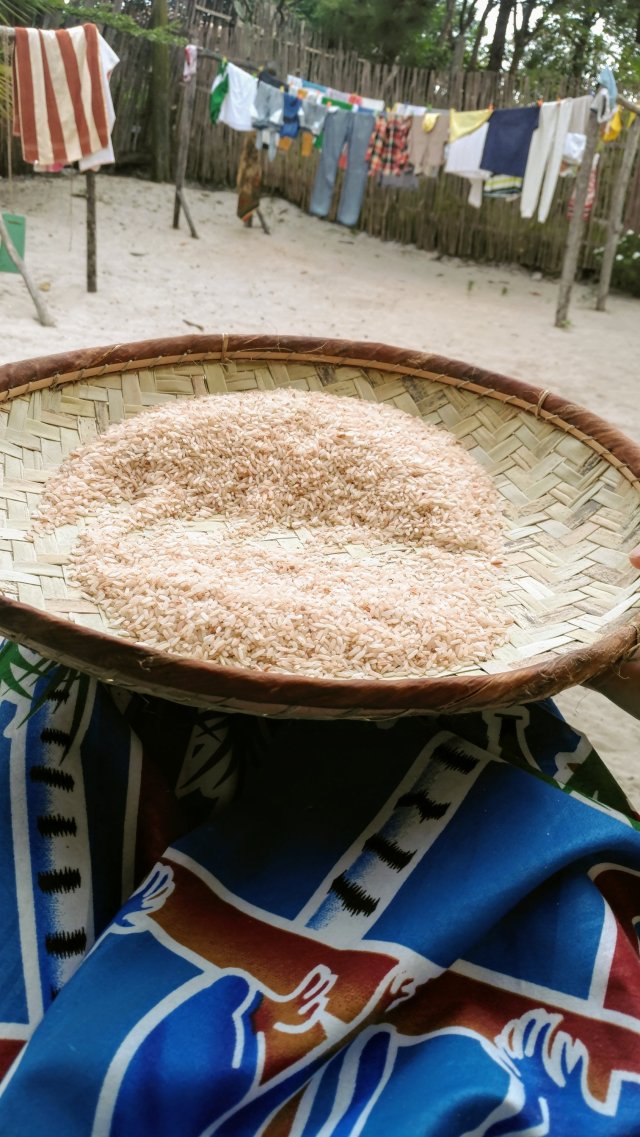
Photo: Sitting in the yard cleaning rice
When an English speaker asks me, “What is your biggest culture shock here?” I answer by making some joke about eating rice. Then, I talk about time and how different the “mora mora” culture is from American lifestyle.
I like to go. I feel fulfilled when I am so busy that there’s no time to eat and no time to sleep. But society doesn’t function that way here.
Recently, I told my host dad that patience is difficult for me. Patience with others isn’t hard, I’ve tested this on several occasions by waiting for hours with my family at the bank and even for professional meetings to start. On the other hand, I am not patient with myself. When it comes to learning Malagasy, I’m frustrated when I don’t understand a simple sentence or forget words that have been explained already. I’m impatient when I see Lucy peel a cassava in under a minute but it takes me ten. My default is to see time as a measure of success. Being fast is equivalent to being good.
My host mom loves to use the proverb time is money. It’s fascinating that we use the verb spend when referring to both time and money. Whenever a seller walks by the house shouting, “Fia!” (Fish) or, “Balahazo!” (Cassava) she waves them down to buy the laoka (side dish) for the next meal. Its worth the money to avoid another trip to the bazaar (market) today. I agree with this proverb, and this use of it is very American. But to be happy in Madagascar, the saying has to mean something completely different to me.
Right after my host mom says this, we spend all day washing the family’s laundry at the river. For each meal, rice is painstakingly picked over, tossed, washed, then finally cooked. With the shopping, preparing, and cooking, the side dish can take hours also. We go to church 2-3 times each week for a three hour service. We worked all weekend baking the perfect cake for a baptism party. The time and money my malagasy mother spends shows how deeply she cares about the people and the God she serves.
Just as we spend more money for the things we value, we spend more time for and with the people we value.
Time is how people show me they care. Sebastian my neighbor takes time to teach me malagasy any time I am home. My friend and bajaj (taxi) driver John took the time to pick me up in the pouring rain and drive me all the way across town without charging me. In conversation, people take time to slow down so I can pick up words and spend time waiting as I try to form a response with my limited vocabulary and grammar. My host family spends time sharing meals, laughing, and helping me find the things I need. The shepherds at the church spend time praying over each and every congregation member at two worship services every day of the week.
I thought giving time would be easy. Aren’t I already giving a year just by showing up? I’m learning its not that simple. Over and over within a day, I have to make a conscious effort to speak even when I know I can’t take the conversation very far. I have to bring energy to every interaction because I’m representing more than just myself. I’m working on spending time on the things I value: to learn, to laugh, to listen, and to be patient.
Every evening before going to sleep, I take one antimalarial pill. Each one is a physical representation of time. Sometimes I focus on how big or small it is. I always notice on how much space it took up, how many are left, and how much empty space is in the bottle. For now, the pills are plentiful, yet their number is finite. Was this tablet, this nugget of time, well spent?
As I fall asleep, I remind mysef there is time for praying. There’s time to invest in learning and in teaching. There is time to wait and time to be assertive. Most of all, there is time to slow down and value this life and the people and things that make it special.

 Alexis in Madagascar!
I am so impressed by your insightful thoughts Alexis…Mrs. Jarvis
LikeLike